
 Roadside Attraction
Stinking Springs (Old Indian Hot Springs)
Roadside Attraction
Stinking Springs (Old Indian Hot Springs)
Corinne, Utah
Overview

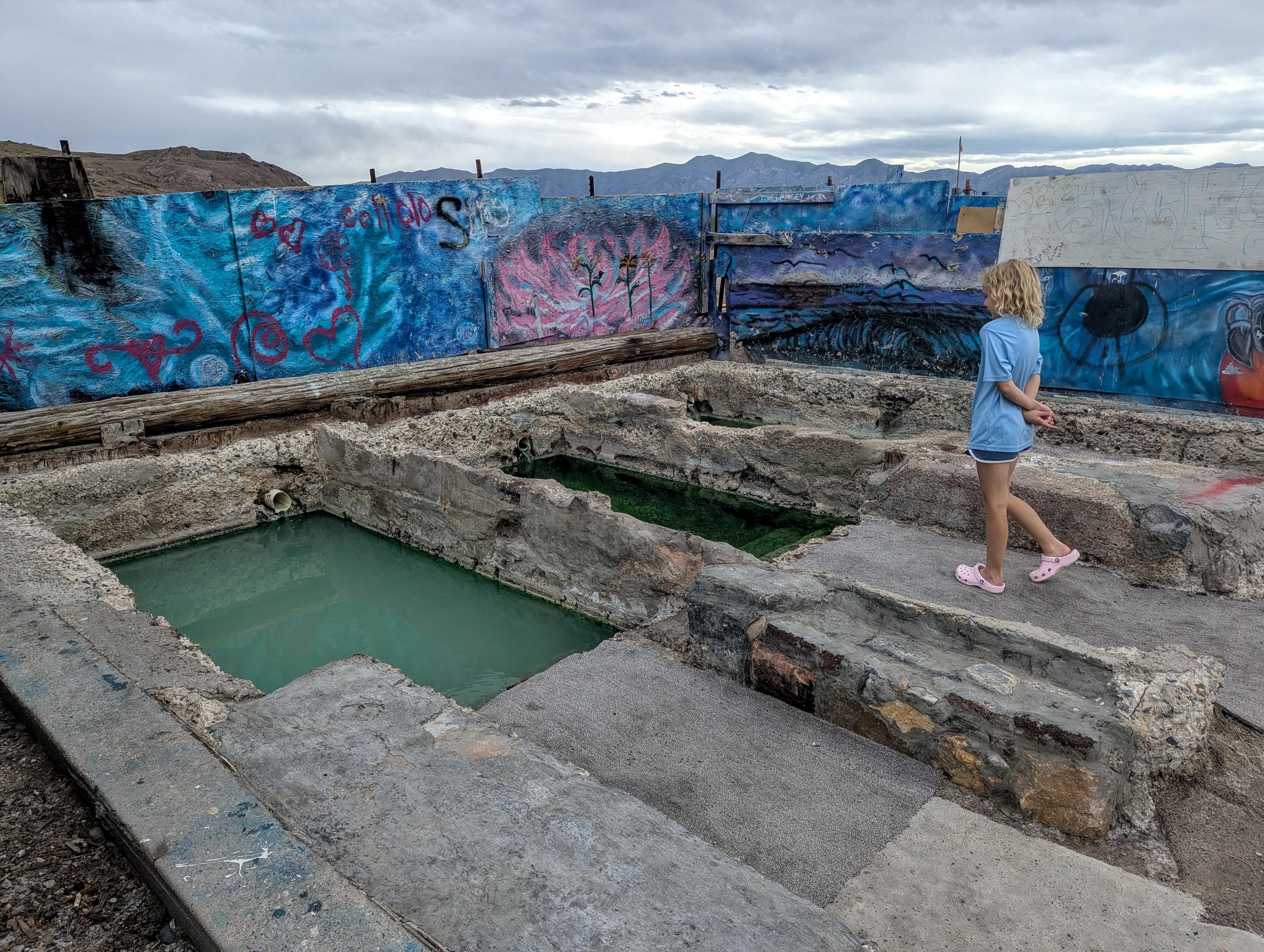
I love a good hot spring! This is one I had heard about years ago and added to my to-do list but was never quite in the area to stop by. Finally in 2026, the family and I stopped by while passing through. This is, indeed, a hot spring, but not one I would get in!!
It has been known by Old Indian Hot Springs, but I think more commonly as Stinking Springs these days for obvious reasons. It has a very strong Sulphur smell. We did not get in the springs on our visit, other than to dip a finger into each of the 3 pools. Neat place, and it would be very popular, except for the smell!
Historically, the water at the main spring vent, which is on the other side (north side) of the road, averages between 113°F and 124°F. By the time it flows into the open-air concrete soaking tubs, it cools down slightly, though the temperature has fluctuated over the last few years due to seismic activity.
The three distinct tubs offer a slight gradient in temperature, usually hovering between 103°F and 113°F.
The springs have an interesting history.
The Shoshone
For centuries, the Northwestern Shoshone traveled through the Bear River Valley and utilized the geothermal springs dotting the region. The Shoshone valued the waters for their deep medicinal and restorative powers.
Chinese Railroad Workers and the Golden Spike
In the late 1860s, the transcontinental railroad raced across Utah, culminating at nearby Promontory Summit in 1869. Hundreds of Chinese laborers were stationed in the area, enduring grueling physical work clearing paths and laying track around the southern tip of Little Mountain.
According to local lore, these workers discovered the highly mineralized waters emerging from the base of the mountain. Seeking relief from grueling days of manual labor, they fashioned primitive cedar soaking tubs over the thermal vents, establishing one of the earliest "soaking resorts" in the territory.
The "Golden Youth" Era (1868–1940s)
The springs were officially "discovered" by Euro-American settlers in 1868. They soon fell into the hands of Hiram House, a prominent pioneer from the nearby boomtown of Corinne - then a raucous, non-Mormon rail city known as the "Gentile Capital of Utah."
It was Hiram’s son, W.F. House, who truly tried to put the spot on the map. House noticed that the springs were incredibly dense with minerals-particularly magnesium sulfate (Epsom salts). He boiled the thermal water down to concentrate the mineral deposits. He then bottled the sludge and sold it across the region as a cure-all elixir named "Golden Youth."
The Decay
Upon his death, the House family allegedly passed ownership of the springs to Box Elder County with a strict, benevolent stipulation: the public must always be allowed to use the healing, sulfurous waters free of charge.
The county agreed to maintain the property and keep it clean. In the mid-20th century, a simple cement-block bathhouse was built to shield soakers from the elements. However, over the subsequent decades, the formal agreement faded from municipal memory. The building was abandoned to the elements, repeatedly targeted by vandals, and eventually stripped of its roof, transforming it into the weathered, graffiti-lined concrete tubs seen today.
Getting There
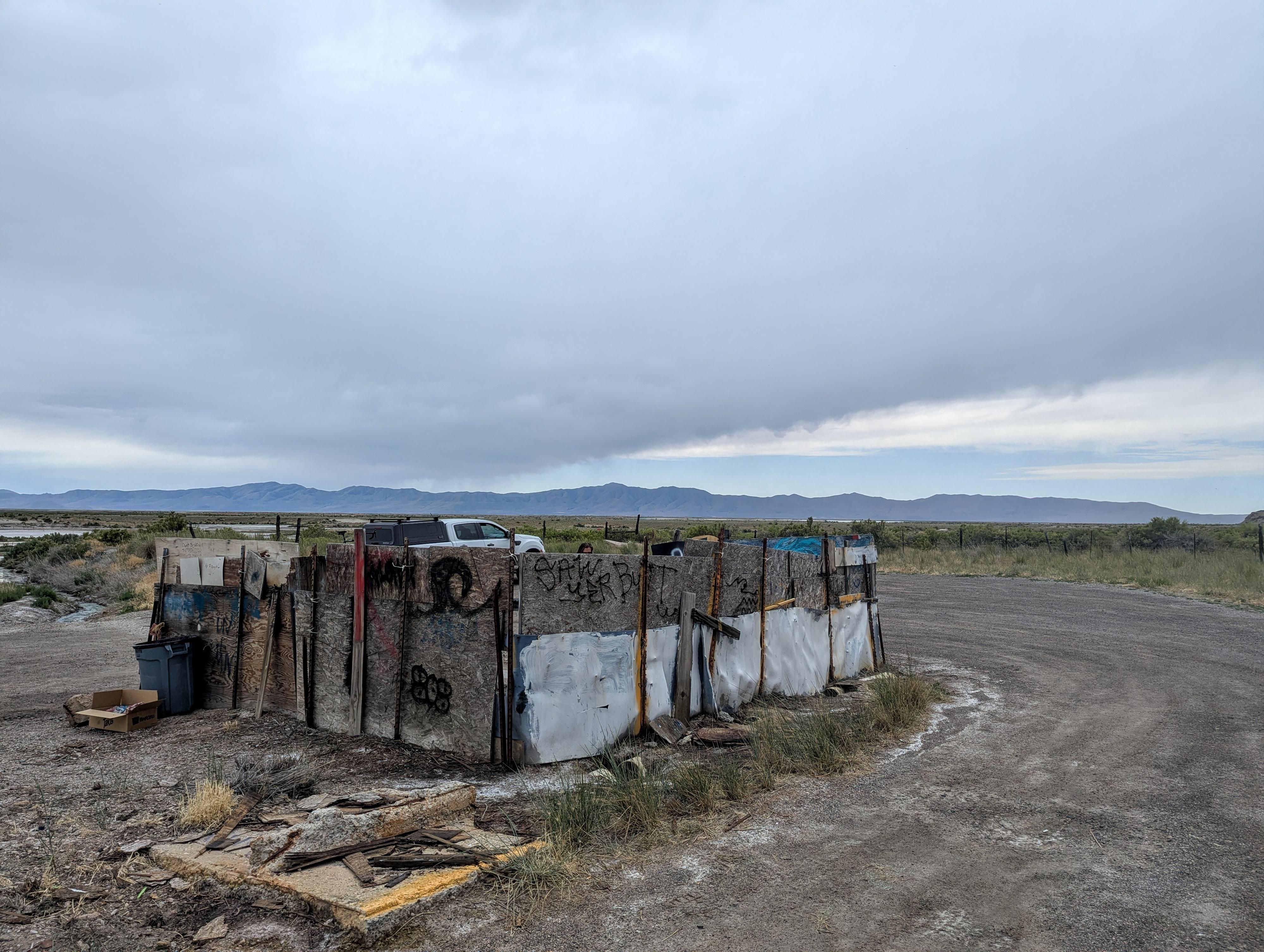
From I-15, take exit 365 and head west to the Corrine on UT-13 for 4 miles. At 4 miles, it crosses 4800W and becomes UT-83. Continue another 5.6 miles past 4800W to the hot spring. The hot spring is on the left side of the road, behind what looks like a shanty wall (as of 2026), but has a large dirt parking area. It is easy to miss because it looks like a shanty wall or trash, but the springs are on the south side of the wall.
Route Description
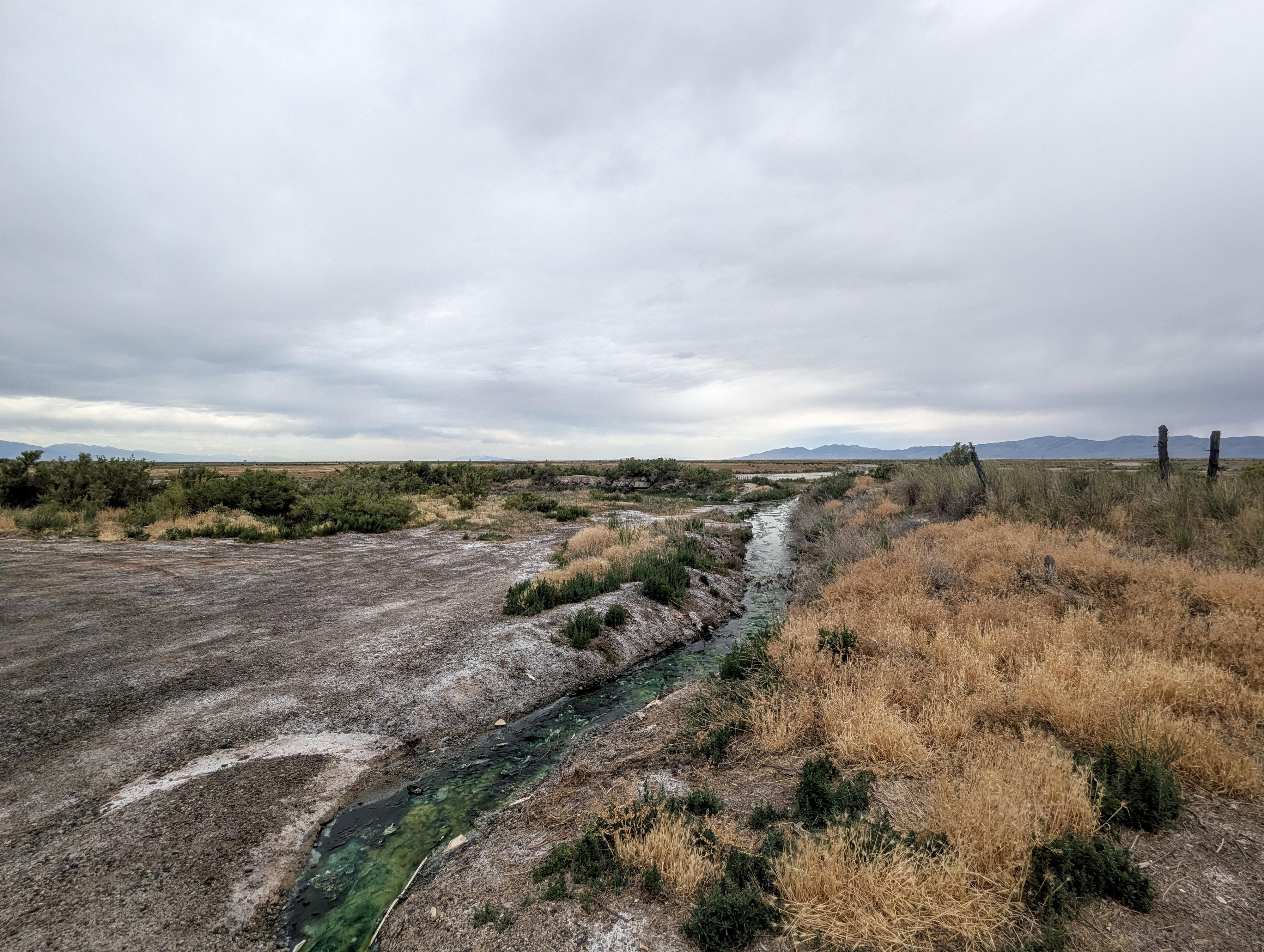
You drive right to the springs. Though we didn't get in, we enjoyed checking them out, as well as both the inflow and outflow from them.
Photos
Maps
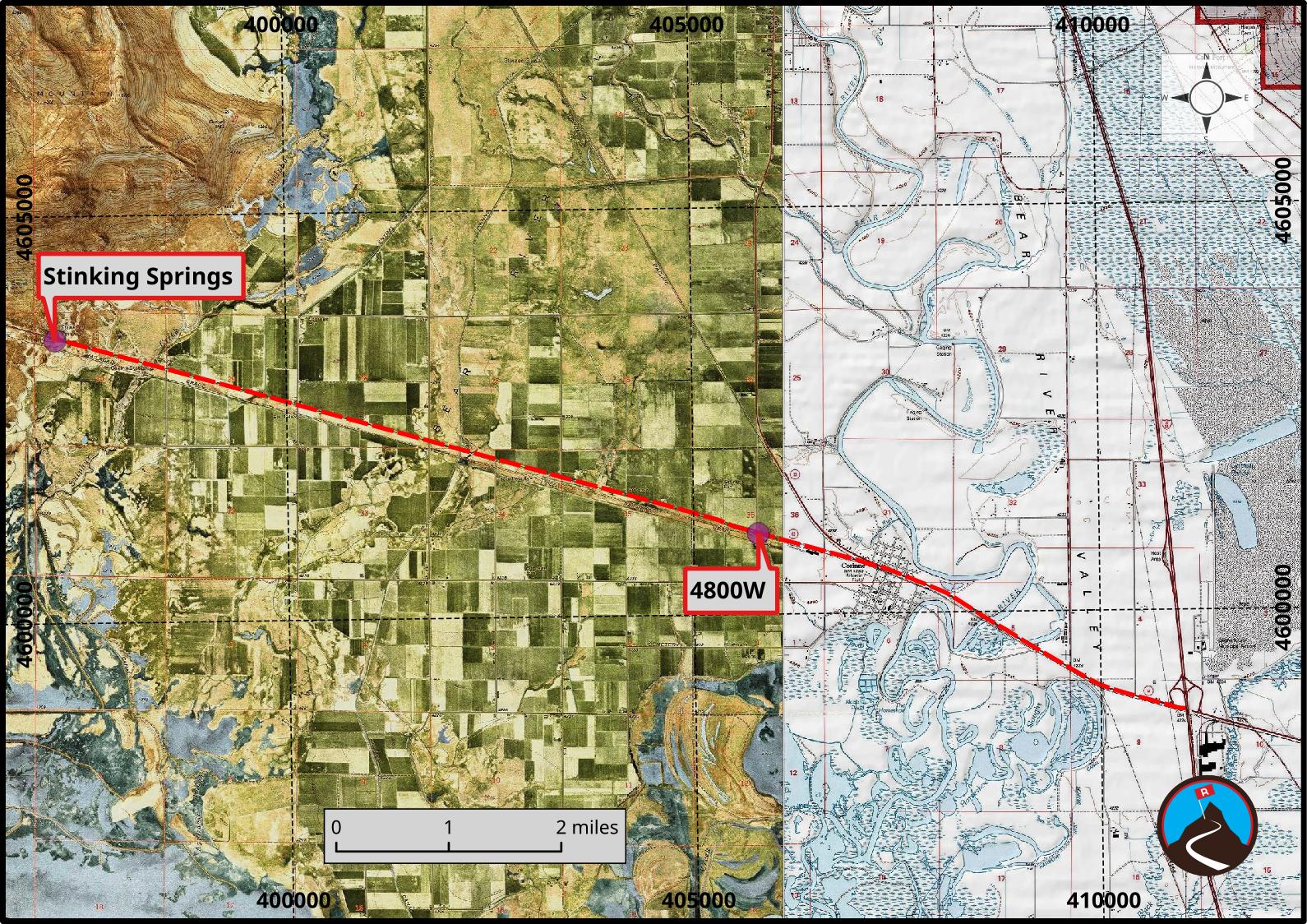
12T 405797E 4600988N
41°33'18"N 112°07'47"W
12T 397152E 4603473N
41°34'35"N 112°14'01"W